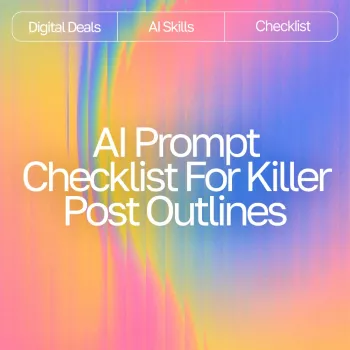
AI Writing Checklist (Digital Download) for Clearer Drafts

AI-Assisted Writing Checklist Download for Faster, Clearer Drafts
A practical checklist and planning system can turn scattered ideas into a clean, publish-ready draft with consistent structure, stronger readability, and fewer rewrites. This digital download is built for creators who want a repeatable process they can run every time they start a new piece—whether it’s a blog post, a newsletter, or a long-form guide.
Instead of relying on motivation or “figuring it out as you go,” the checklist keeps you moving in a predictable sequence: decide what the piece must accomplish, map the sections, confirm the essentials, then draft with fewer detours. The result is often a clearer first pass, fewer missing pieces, and edits that feel like refinements rather than rescues.
What this digital download helps with
- Creates a repeatable planning routine that reduces blank-page friction
- Keeps sections logically ordered so readers can scan and understand quickly
- Encourages completeness by verifying essentials before drafting begins
- Improves consistency across posts, newsletters, and long-form pages
- Cuts revision time by catching gaps early (examples, definitions, next steps)
Strong writing is rarely about “more words.” It’s about fewer dead ends: fewer repeated points, fewer missing definitions, and fewer paragraphs that wander away from the reader’s needs. A short pre-draft routine can prevent most of those problems before they start.
What’s inside
- A step-by-step checklist that guides idea shaping, section planning, and draft readiness
- Fill-in planning blocks for audience, angle, key takeaways, and supporting notes
- Quality checks for clarity, flow, and completeness before publishing
- A simple workflow map that shows what to do first, next, and last
Download contents at a glance
| Component | Purpose | When to use it |
|---|---|---|
| Planning checklist | Turns a topic into an organized structure | Before writing the first paragraph |
| Workflow guide | Provides an order of operations to avoid rework | At the start of each project |
| Readability checks | Verifies clarity, transitions, and examples | After drafting, before editing |
| Consistency checks | Keeps tone, formatting, and section order uniform | Right before publishing |
A simple workflow you can reuse every time
This download is designed to support a clean, repeatable loop. The steps below are intentionally simple—simple enough to follow on busy days, but structured enough to produce better drafts.
- Choose a single goal for the piece (teach, compare, troubleshoot, or inspire action)
- Define the reader’s starting point and the finish line (what changes after reading)
- Draft section headers in a logical sequence (from basics to action steps)
- Add supporting bullets under each header (facts, examples, mini-steps, cautions)
- Do a quick completeness pass (missing definitions, missing examples, missing next step)
- Draft quickly, then revise for clarity and flow
For web reading, structure matters because people scan before they commit. Clear headings, short paragraphs, and helpful transitions reduce friction and keep the reader oriented. Helpful guidance on web readability is worth bookmarking from Nielsen Norman Group’s web writing recommendations.
How to use it with an AI writing assistant
This checklist works well alongside an AI writing assistant when you keep control of the direction and constraints. The checklist becomes your “non-negotiables,” so the assistant doesn’t drift into irrelevant points or skip what matters most to your audience.
- Treat the checklist as the “brief” so the assistant receives clear constraints and goals
- Start with short, specific inputs: audience, outcome, tone, and must-include points
- Generate one section at a time to maintain control and reduce tangents
- Ask for alternatives only where needed (hook options, subhead variations, summary options)
- Verify facts and add original experience, data, or examples to strengthen credibility
Quality and trust improve when content is built to help real readers, not to chase shortcuts. Google’s guidance on helpful, reliable, people-first content offers a clear standard for what “good” looks like over time: Google Search Central: Creating helpful, reliable, people-first content.
Best fit for creators and teams
- Bloggers and niche site owners who want a dependable pre-draft routine
- Small business owners creating product pages, guides, and knowledge-base posts
- Freelance writers who need a consistent system across different clients
- Content managers standardizing quality across multiple contributors
- New writers who want guardrails without losing creativity
Consistency is especially valuable when multiple people contribute. A shared checklist reduces variance in tone, section order, and completeness—so readers know what to expect and editors spend less time fixing preventable issues.
Practical quality checks before publishing
- Does the opening quickly state the problem and who the solution is for?
- Do sections progress naturally, with smooth transitions and no repeated points?
- Are key terms explained the first time they appear?
- Does every major claim have support (example, source, or clear reasoning)?
- Is there a clear next step at the end (apply, download, compare, or troubleshoot)?
These checks are simple, but they’re the difference between content that feels “pretty good” and content that feels confidently finished. When the opening is specific, the middle is organized, and the ending tells the reader what to do next, the piece earns trust.
Format, delivery, and usage notes
Related picks (in stock)
- AI-assisted writing checklist download
- A Simple System for an Organized Pantry – 10 in 1 Bundle of Guides, eBooks & Checklists
- Shape-Savvy Style for Triangle Figures: The Ultimate Guide to Dressing Your Triangle Body Shape
FAQ
Is this a physical item or a digital file?
This is a digital download delivered after purchase. Nothing is shipped, and you can access the file immediately.
Can it be used for different types of writing beyond blog posts?
Yes. The structure adapts well to guides, landing pages, newsletters, and long-form educational content because it focuses on clarity, order, and completeness.
Does it work with any AI writing tool?
Yes. The checklist is tool-agnostic and can be followed with or without an assistant, so it fits whatever setup you already use.











Leave a comment