Why Kids Hit: Gentle Parenting Scripts & Solutions

Understanding Why Kids Hit and How to Guide Them
Hitting is a common behavior in early childhood, but it can feel alarming and personal in the moment. Gentle parenting focuses on safety, calm limits, and teaching skills a child doesn’t have yet—like communicating, waiting, and handling big feelings. The goal is to stop the harm right away, understand what’s driving it, and build new ways to cope that actually stick.
What Hitting Usually Means (and What It Doesn’t)
For many toddlers and preschoolers, hitting is less about “being mean” and more about using the fastest tool available when the brain can’t yet access words or self-control. In early development, the body often acts before the thinking part of the brain can step in.
- A developing brain using the quickest tool it has when words, patience, or self-control aren’t available yet.
- A signal of unmet needs: connection, rest, movement, boundaries, predictability, or help with transitions.
- Not proof of a “bad kid” or a future aggressive personality; behavior is communication plus skill gaps.
- Most common between ages 1–4, when impulse control and language are still emerging.
If you want a helpful “north star,” aim for two outcomes: stop the harm immediately and teach the skill later (when your child can actually learn).
Common Reasons Kids Hit Others
Hitting looks similar from the outside, but the “why” can vary a lot. Getting curious about the cause helps you respond in a way that reduces repeat incidents.
- Big feelings with limited language: frustration, jealousy, embarrassment, excitement, or overwhelm.
- Impulse and sensory needs: some kids seek strong input (pushing, grabbing) when dysregulated.
- Power and autonomy struggles: “No” feels like a wall, so the body reacts before thinking.
- Difficulty with waiting and sharing: abstract concepts that require practiced skills and support.
- Connection-seeking: negative attention can still feel like closeness when a child feels disconnected.
- Modeling: siblings, peers, media, or adults using harsh physical responses can shape behavior.
- Stress factors: hunger, fatigue, too many transitions, overstimulation, or big family changes.
Authoritative guidance from the American Academy of Pediatrics and the CDC Essentials for Parenting emphasizes consistent limits paired with skill-building—especially for toddlers who are still learning regulation.
What to Do in the Moment: Safety First, Then Teaching
When a child hits, the immediate priority is protecting bodies. The second priority is communicating a clear, calm limit. Teaching and problem-solving come later, after everyone is regulated.
- Block and separate: move between children, gently hold hands if needed, and create a few feet of space.
- Use a short limit: “I won’t let you hit.” Avoid long lectures while the child is escalated.
- Attend to the hurt child first when possible; it reinforces empathy and makes the boundary clear.
- Stay regulated: lower voice, slow movements, and breathe—calm is contagious.
- Name what happened and what to do instead: “You wanted the toy. Say ‘my turn next’ or tap my arm for help.”
- If the child continues, relocate together (not a punitive exile): “We’ll take space until your hands are safe.”
Fast Responses That Teach
| Situation | What the child may need | Gentle limit + script |
|---|---|---|
| Hitting during sharing | Help waiting; clear turn-taking | “I won’t let you hit. It’s hard to wait. Let’s use the timer—your turn is next.” |
| Hitting when told “no” | Support with disappointment; alternative choices | “No hitting. You’re mad. You can stomp feet or squeeze this pillow. Want A or B?” |
| Hitting to get attention | Connection; co-regulation | “Hands stay gentle. I’m here. Tap my arm and say ‘play with me’—let’s do 2 minutes together.” |
| Hitting when overstimulated | Less input; a break | “Stop—hands safe. Your body needs space. Let’s go to a quiet corner and breathe.” |
After the Moment: Repair, Practice, and Problem-Solve
Once calm returns, that’s when learning can happen. Keep it short, warm, and specific so your child can remember what to do next time.
For more development context and practical toddler strategies, resources from ZERO TO THREE can be especially helpful.
Prevention That Works: Meeting Needs Before the Swat
When to Get Extra Support
A Deeper Gentle Parenting Plan (Printable Support)
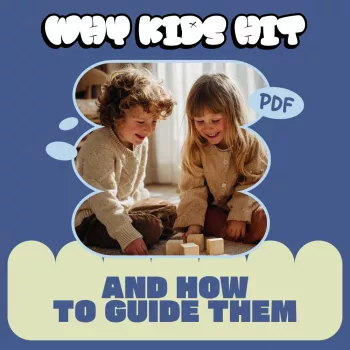
- For step-by-step scripts, common scenario breakdowns, and practice activities, use: Understanding Why Kids Hit and How to Guide Them – A Gentle Parenting Guide Exploring kids hitting others reasons.
- Helpful for caregivers who want consistent language across home, childcare, and co-parenting situations.
- Pairs well with tracking triggers and practicing replacement skills during calm moments.
If home routines feel chaotic (which can increase overstimulation and conflict), simplifying systems can also support calmer days. Some families find it helpful to streamline snack and meal flow using A Simple System for an Organized Pantry – 10 in 1 Bundle of Guides, eBooks & Checklists so transitions and hunger-related meltdowns are easier to manage.
FAQ
Should a child be punished for hitting?
Safety and a firm limit come first, but punishment alone usually doesn’t teach the missing skills. Logical consequences, repair, and practicing alternatives (like asking for help or taking space) are more likely to reduce hitting over time.
What do you say to a toddler who hits?
Use a short, clear boundary like “I won’t let you hit,” then offer one simple alternative: “You’re mad—stomp your feet,” or “Tap my arm and say ‘help please.’” Keep it brief until your child is calm enough to learn.
Is it normal for a 2-year-old to hit other kids?
Yes, it can be common at age two because impulse control and language are still developing. If it’s frequent, injurious, or getting worse across settings, check in with your pediatrician for additional support.











Leave a comment