Sustainable Movement Habits: A Daily Routine That Sticks
Why Sustainable Movement Matters More Than “Perfect” Workouts
An active lifestyle doesn’t require epic workouts, expensive equipment, or a strict schedule. What lasts is movement that fits real life: busy mornings, low-energy evenings, travel days, and weeks when motivation dips. Sustainable movement habits prioritize small actions you can repeat—because consistency compounds in a way that occasional intensity can’t.
Health organizations broadly agree that regular activity supports long-term wellness, including heart health, mood, strength, and mobility. If you want a simple north star for general guidelines, see the CDC benefits of physical activity and the World Health Organization physical activity overview.
What “Sustainable Movement” Really Means
- Repeatability over intensity: a habit done 5–6 days a week beats a hard session done once.
- Flexible options: standing breaks, short walks, mobility, strength “snacks,” and play all count.
- Fits personal constraints: time, energy, pain levels, equipment, and environment.
- Identity and systems: movement becomes part of daily life rather than an occasional project.
Instead of asking, “What’s the best workout?” ask, “What’s the easiest version I can repeat even when life gets messy?” That one shift reduces burnout and makes progress feel automatic.
Start With a Minimum Baseline (Your Non-Negotiable)
A baseline is the smallest meaningful movement you’ll do even on your busiest day. Think of it as the minimum deposit into your long-term wellness “account.”
- Choose a baseline you can do anywhere: a 5-minute walk, 8-minute mobility, or 10 squats + 10 wall push-ups.
- Define success as completion: the question is “Did it happen?” not “Was it impressive?”
- Attach it to an anchor: after coffee, after the school drop-off, or before your shower.
- Keep it pain-aware: discomfort is a signal to scale range of motion, pace, or duration.
If you tend to restart often, your baseline is probably too ambitious. Make it smaller until it becomes nearly inevitable.
A Simple Daily Movement Routine (15–25 Minutes Total)
This routine is designed to be quick, repeatable, and adjustable. Do it at home, at the gym, or while traveling—swap movements as needed.
1) Warm-up (2–3 minutes)
- Gentle marching in place
- Arm circles
- Hip circles
- Easy toe taps
2) Mobility (5–7 minutes)
- Thoracic rotations (easy twist, breathing steadily)
- Hip flexor opener (short holds, no forcing)
- Ankle rocks
- Gentle forward fold variations (bend knees as needed)
3) Strength (6–10 minutes)
Pick 2–3 movements total. Keep the effort “pleasantly challenging,” leaving a little in the tank.
- Squat pattern: sit-to-stand, bodyweight squats, or box squats
- Hinge pattern: hip hinges, light deadlifts, or good mornings
- Push: wall push-ups, incline push-ups, or overhead press (light)
- Pull: band rows, dumbbell rows, or doorframe rows (safe setup)
- Carry: farmer carry with groceries or light weights
4) Low-intensity finish (3–5 minutes)
- Short walk (indoors or outside)
- Step-ups on a sturdy step
- Relaxed cycling to downshift stress
Optional add-on (5–10 minutes)
If energy is high, add time—but it’s never required for the habit to count. The goal is to protect the streak, not chase perfection.
Pick-Your-Path Weekly Micro-Routine (Mix and Match)
| Day | Baseline (5–10 min) | Main Focus (10–15 min) | If Time Allows (5–10 min) |
|---|---|---|---|
| Mon | 5-min walk | Lower body strength (squats/hinges) | Easy mobility flow |
| Tue | 8-min mobility | Brisk walk or cycling | Core + posture (dead bug, rows) |
| Wed | 5-min walk | Upper body strength (push/pull) | Stretch calves/hips |
| Thu | 8-min mobility | Intervals: 30s faster / 60s easy x 8 | Balance practice (single-leg holds) |
| Fri | 5-min walk | Full-body circuit (2 rounds) | Relaxed walk outdoors |
| Sat | Choose one | Longer enjoyable movement (hike, sport, errands on foot) | Light mobility |
| Sun | Choose one | Recovery movement (gentle walk, yoga, stretching) | Plan anchors for next week |
Consistency That Survives Real Life
- Use “if-then” rules: If meetings run late, then do the baseline right after dinner.
- Create a default window: a 30–60 minute block where movement can happen in any form.
- Lower friction: shoes by the door, mat unrolled, resistance band visible, playlist ready.
- Track the habit, not the outcome: checkmarks for days moved; review patterns weekly.
- Plan for interruptions: travel, illness, and busy seasons get a reduced baseline—not a full stop.
Common Barriers (and Simple Fixes)
Progress Without Burnout
Tools That Make Movement Easier to Stick With
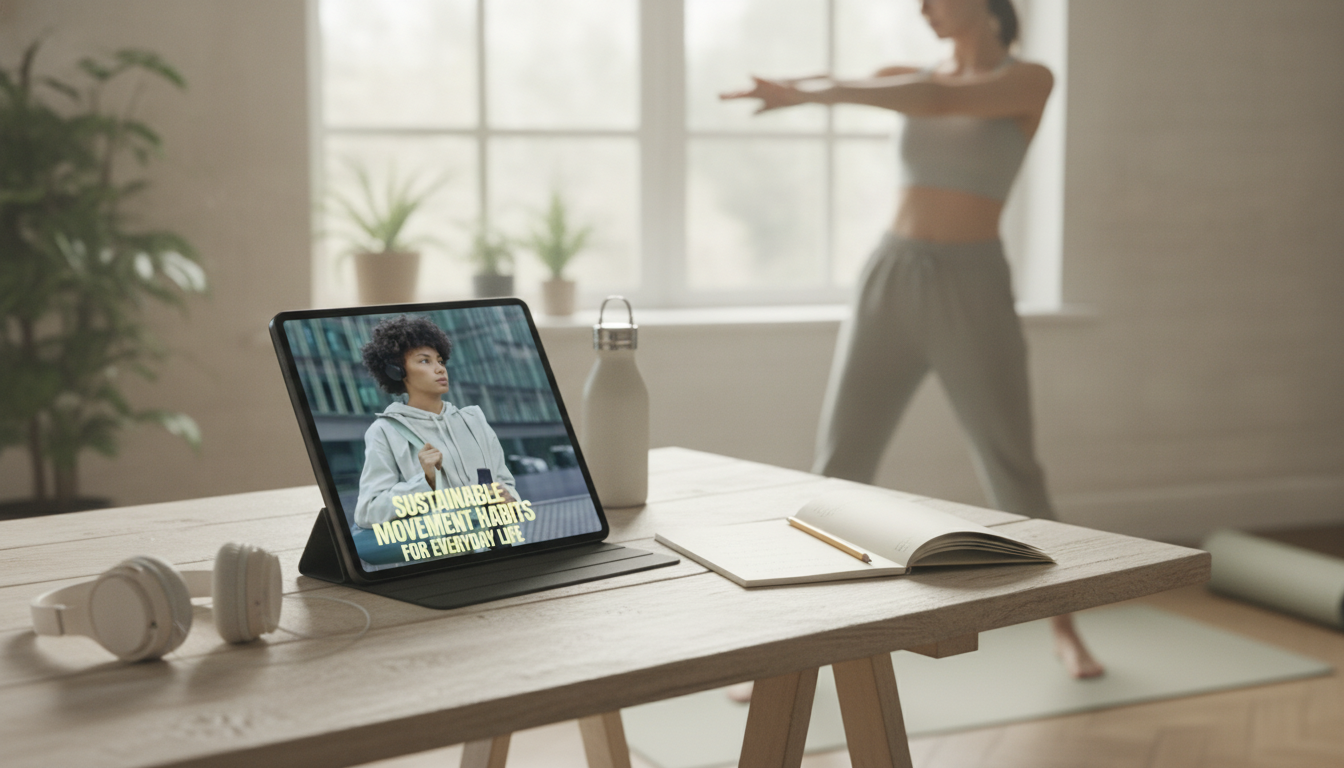
If you want a plug-and-play structure that reduces decision fatigue, the Sustainable Movement Habits For Everyday Life (digital guide) lays out baselines, scalable routines, and consistency tools for real schedules and fluctuating energy.
Friction is often the hidden problem. A supportive home setup can help—whether that’s simplifying meal prep systems with A Simple System for an Organized Pantry – 10 in 1 Bundle of Guides, eBooks & Checklists or streamlining daily choices (including what you wear for a walk) with Shape-Savvy Style for Triangle Figures.
Quick Start: Your Next 24 Hours
FAQ
How long does it take to build a movement habit that sticks?
It varies by person, but habits stick faster when the baseline is easy enough to repeat for several weeks. Focus on anchors and “if-then” backup plans, and track consistency instead of waiting for motivation to show up.
What’s the best daily movement routine for beginners with limited time?
A reliable option is 15–20 minutes: a short warm-up, a few minutes of mobility, 1–2 simple strength moves, and a brief walk. On busy days, split it into two short blocks and fall back to your minimum baseline.
Does walking count as enough movement for long-term wellness?
Yes—walking is valuable, especially when it’s consistent and gradually progresses in time or pace. For more balanced support, add light strength and mobility a few days per week.










Leave a comment